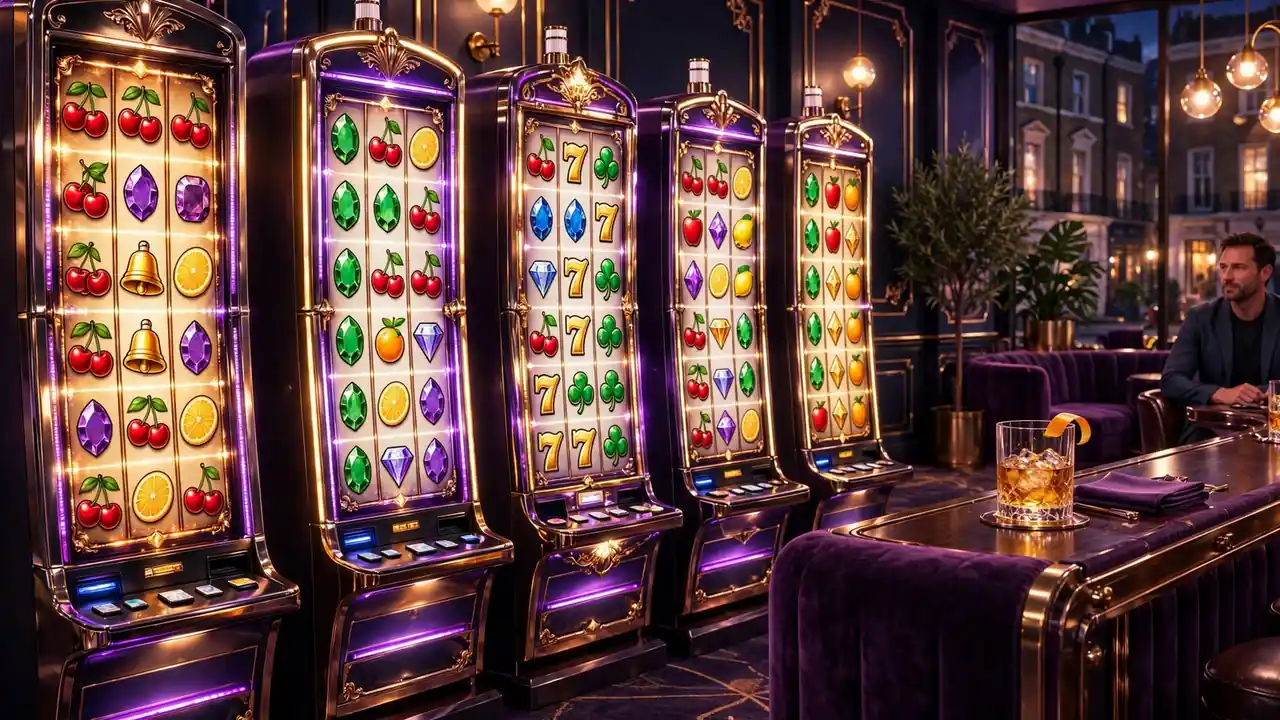
Bonus-Buy Slots in the UK: Features and Volatility
A practical guide to how bonus buys fit within a spin, how volatility affects outcomes, and what demo play can—and cannot—reveal.

Table of Contents
- How Slot Volatility Shapes Bonus-Buy Sessions
- Bonus-Buy Features at UK Online Casinos
- What Free Bonus-Buy Play Can and Cannot Show
- What Buying a Slot Bonus Means
- Which Slot Machines Offer a Bonus-Buy Feature
- Bonus-Buy Casinos and GamStop: The UK Context
- Identifying Bonus-Buy Games Without an Unsupported Ranking
- How Bonus Buys Fit Within a Slot Spin
- Using Demo Play to Examine a Bonus Feature
- Bonus-Buy Features and the Wins They Modify
How Slot Volatility Shapes Bonus-Buy Sessions
Volatility describes how a slot distributes its returns, not whether a particular session will produce a win. Low-volatility games tend to return value through frequent, smaller wins. High-volatility games produce winning outcomes less often, with larger amounts when they occur. These patterns can affect how a bonus-buy session feels, but they do not provide a forecast of its result.
In low-volatility slots, winning combinations are typically reported every three to six spins on average across most titles. That is a description of a broad pattern, not a schedule: it does not mean a win is due after a set number of losing spins. Nor does it establish that a bonus round will be profitable. A run of frequent small wins can still leave the total return below the amount staked.
High-volatility games have a different distribution. Wins tend to occur less often, while some individual wins may be larger. As a result, the balance can move unevenly during play. A quiet spell does not show that a substantial win is becoming more likely, and a large win does not make another one more probable. Volatility concerns the range and frequency of outcomes across play, rather than the timing of the next result.
Casino Apps in the UK: Mobile Access and Features
This distinction matters when a slot offers a bonus-buy option. Paying to access a bonus round changes the way a session begins, but volatility remains relevant to the outcomes the game can produce. A bonus feature in a lower-volatility game may sit within a broader pattern of smaller, more frequent returns; in a higher-volatility game, a bonus outcome may be less frequent and more variable. Neither description establishes what an individual purchase will return. The feature’s presence does not turn an uncertain result into a predictable one.
Low volatility is sometimes mistaken for lower risk in every meaningful sense. It can mean that returns are spread across more frequent, smaller wins, but it does not remove the possibility of losing the stake. Likewise, high volatility is not proof that a game offers better value. The size of a possible win and the frequency of wins are separate from the long-run relationship between stakes and returns.
That relationship is expressed through mathematical expectation. Where a game has a positive house edge, its expected result for the player is negative when considered over a sufficiently large number of sessions. The pace of that disadvantage can vary: frequent small returns may make losses less abrupt, while less frequent larger wins can produce wider swings. Neither pattern changes the underlying expectation. A short session may depart from the long-run tendency in either direction, but it cannot be treated as evidence that the tendency has changed.
Best RTP Casino Slots UK: What RTP Really Means
Some general characteristics are associated with low-volatility slots. They commonly use five reels and at least twenty-five paylines; their jackpot amounts tend to be fixed rather than drawn from progressive pools. Their bonus rounds may apply multipliers to wins accumulated during the feature. These traits help describe a style of game, but they are not a universal specification, and they do not establish how a particular bonus buy will perform. Individual games can differ in their rules and return structure.
For bonus-buy slots in the UK, volatility is therefore best understood as context for interpreting a possible range of play, rather than a selection tool that can identify a favourable outcome. A game with frequent smaller wins can still return less than it takes in, while one with infrequent larger wins can produce a loss over a session. The label does not predict when wins will appear, how large a bonus result will be, or whether a session will end ahead.
Comparisons are most meaningful when they keep these ideas separate. Volatility describes the distribution and rhythm of returns; mathematical expectation concerns the average result over extensive play. Neither should be confused with an assurance about one bonus round. A bonus-buy session may feel more or less uneven depending on the game’s volatility, but that feeling is not evidence of a change in the game’s underlying mathematics.
Bonus-Buy Features at UK Online Casinos
A slot’s bonus-buy option sits within a wider service provided by an online casino: the operator makes games available, manages customer accounts and accepts gambling activity under the rules that apply to its market. For a casino bonus buy in the UK, the relevant question is therefore not only whether a particular game displays the feature, but whether the operator offering it is authorised to serve customers in Great Britain.
The UK Gambling Commission regulates remote gambling offered to consumers in Great Britain, regardless of where the operator’s technical infrastructure or servers are located.
The UK Gambling Commission regulates commercial gambling in Great Britain, including online casino activity. Its remit covers remote gambling offered to consumers in Great Britain even when the operator’s key equipment is located elsewhere. The location of servers or other technical infrastructure does not, by itself, remove an operator from the licensing framework when it is providing remote gambling to this market.
The Commission is the sole regulator for commercial gambling in Great Britain. It issues operating licences to businesses and personal licences to individuals who perform specified roles in the gambling industry. These are distinct forms of authorisation: an operating licence relates to the business activity, while a personal licence applies to an individual. A company’s presence online, or its ability to display casino games, should not be treated as evidence that it holds the required authorisation.
What licensing means for casino access
A site promoting slots with bonus-buy features may be operated by a business based in Britain or elsewhere. For consumers in Great Britain, the material issue is whether the operator holds the relevant UK Gambling Commission licence for the gambling it offers. The regulatory test concerns the service to the market, not simply the country in which the business is incorporated or its equipment is hosted.
This distinction matters because online casino branding and game menus do not establish an operator’s regulatory status. A site may present itself as a UK casino, accept registrations from British customers or list familiar slot providers; none of those details substitutes for checking the operator’s licence. The licence belongs to the business, rather than to an individual slot feature, and it is the operator’s authorisation that provides the regulatory context for accessing casino games.
Video Slots in the UK: Reels, RTP and Volatility
The Gambling Commission’s framework also distinguishes businesses from individuals. Operating licences authorise relevant gambling businesses, while personal licences apply to individuals in roles covered by the licensing system. These categories should not be conflated when assessing an online casino: a personal licence is not a substitute for the operating licence required by the business offering gambling.
Checking an operator’s status
The Commission maintains a public register through which an operator’s licensing details can be checked. Before depositing, the licence number should be verified against that register. This is more reliable than relying only on a logo, a statement in a site footer or a general claim that the casino is regulated. The operator name and licence details should correspond to the business actually providing the gambling service.
A licence check is a regulatory check, not an assessment of whether a casino’s games suit a particular player or whether a bonus-buy feature will produce a favourable result. It establishes whether the operator is authorised within the relevant framework. It does not turn any individual game outcome into a predictable one, nor does the presence of a feature itself demonstrate that the casino is licensed.
The distinction is useful when comparing online casinos that advertise access to slots with a purchase feature. Game availability can change between operators and over time, but the basic licensing question remains with the business offering the service. Descriptions such as “casino with bonus buy” identify a type of game selection; they do not, on their own, identify a regulated operator.
Do
- Verify the operator’s licence number against the public register
- Check that the licence belongs to the business providing the service
Don’t
- Rely solely on a logo or statement in a site footer
- Assume a site is licensed because it accepts British customers
Scope of the UK framework
The wording “UK casino” is commonly used for the market, but the regulatory scope needs precision. The Gambling Commission regulates commercial gambling in Great Britain, and its remote-gambling remit applies to services offered to consumers there irrespective of the location of key equipment. The Gambling Act 2005 governs gambling in England, Wales and Scotland; it does not govern Northern Ireland. These distinctions mean that a broad label should not obscure which jurisdiction and regulatory arrangements are relevant.
For a customer considering an online casino, the practical implication is that an offshore location does not automatically exempt a remote operator from the requirements that apply when it offers gambling to consumers in Great Britain. Equally, a site’s claim to be international or its use of overseas infrastructure is not a licence. The operator’s status needs to be established through the regulator’s records.
This context applies whether the casino offers standard slot play or games that include a bonus-buy option. The feature does not create a separate regulatory category for the casino: access is provided through the operator’s gambling service. As a result, the operator’s authorisation is the appropriate starting point for assessing the UK context, while the presence of particular games remains a separate matter that can vary by site.
What Free Bonus-Buy Play Can and Cannot Show
Free-play versions of slots can provide a way to encounter a bonus-buy feature without staking real money. The distinction is fundamental: the balance shown in a free session is simulated, and any wins remain within that simulation. No cash or other real-money payout is awarded.
3-Reel Slots in the UK: How the Format Works
A free session can show how a game presents its controls and what happens when a bonus feature is selected. It may also help clarify the visual form of the feature and the kinds of game information displayed around it. These observations concern the software’s presentation, not the financial value of a real-money session.
The limits matter because a simulated balance does not behave as evidence of future returns. A favourable sequence in free play does not establish that the same sequence, or a similar result, will occur when money is staked. Nor does an unfavourable run demonstrate that real-money play would produce a different outcome. Each session provides an observed sample, not a reliable forecast.
Free play also cannot establish the practical cost or consequences of using a bonus-buy feature with real funds. The simulated balance is not money at risk, so its movement does not represent a player’s financial loss or gain. Results in the demo should not be treated as a substitute for a record of real-money outcomes.
This distinction is especially important when a free version makes repeated play easy. A long series of simulated rounds may create a strong impression of how often a feature appears to pay, but the impression remains tied to that particular sequence. It does not remove randomness or turn past results into a prediction. For games with a positive house edge, the mathematical expectation is negative over enough sessions, even when losses accumulate gradually. A free session cannot reverse that underlying relationship.
A favourable sequence in free play does not establish that the same or similar results will occur when real money is staked.
The phrase “free bonus-buy slots” can therefore describe a way to access a slot’s feature in a no-stakes setting, but “free” refers to the absence of a real-money stake, not to a cash prize. The displayed credits are fictional, and the session does not generate withdrawable winnings. This makes the format materially different from real money slots, even if the screen and game rules appear similar.
Free play can be useful for familiarisation, provided its evidential limits remain clear. It can show what the game displays and how a feature is represented in the software. It cannot establish that a real-money purchase will be profitable, indicate the likelihood of a particular payout, or guarantee that a future session will resemble the demo. Those conclusions do not follow from simulated results.
Accordingly, free play is best understood as an observation of a game in a simulated environment, not as a trial run that predicts financial outcomes. The apparent result belongs to the demo session alone.
What Buying a Slot Bonus Means
A bonus buy is a slot feature that lets a player pay for entry to a bonus round instead of waiting for the round to be triggered through ordinary spins. The purchase changes how the feature is accessed; it does not turn the bonus into a separate game. The reels, paytable and rules still belong to the underlying slot, while the bonus round is one part of its design.
Highest RTP Slots in the UK: What RTP Can Show
The term can be misleading if “buy” is taken to mean acquiring a prize or a guaranteed payout. The payment buys access to a feature, not a particular result. Once the round begins, its outcome remains uncertain. It may produce a return, a smaller amount than the cost of entry, or no return at all. A bonus round is not evidence that a session will be profitable, and purchasing access does not remove the chance of losing the stake.
The distinction is between paying to enter a game feature and paying for an outcome. A bonus buy is the former. Its price is a cost associated with access, not a forecast of what the round will return. The feature may be presented as a shortcut to a part of the slot that could otherwise be reached through play, but that description concerns the route into the round, not its financial value.
This also explains why a bonus buy does not necessarily alter the rest of a slot’s structure. A game can retain its regular reels, winning combinations and other features while offering a paid entry to a particular bonus round. The purchase does not imply that every spin includes the bonus, nor that a bonus round will repeat the same sequence or award the same result. The feature’s rules determine what happens within it.
Some low-volatility slots are characterised by five reels and at least twenty-five paylines, with fixed jackpot amounts rather than progressive pools. Their bonus rounds may use multipliers applied to wins accumulated during the feature. Those design details describe possible ways a slot structures play; they do not establish the value of buying entry to its bonus. A multiplier affects the relevant accumulated wins under the game’s rules, rather than guaranteeing that a win will be accumulated.
Low-volatility slot characteristics
Some low-volatility slots commonly use five reels and at least twenty-five paylines, with fixed jackpot amounts rather than progressive pools. Their bonus rounds may apply multipliers to wins accumulated during the feature.
The phrase “best slot to buy a bonus” therefore has no single answer on the basis of the feature alone. A bonus buy can be compared by what it offers access to and by the game rules governing the round, but the label “best” cannot establish that one purchase will produce a better result. The relevant distinction is not between a safe and risky purchase: access is purchased, while the result remains uncertain.
In short, buying a slot bonus means paying to enter a bonus feature within that slot. It is neither a separate slot nor a promise of winnings. The feature’s presentation and mechanics may differ between games, but the purchase should not be confused with buying a predictable return.
Which Slot Machines Offer a Bonus-Buy Feature
Bonus-buy availability belongs to an individual slot game. It is not a standard control found on every machine, and the appearance of a familiar reel layout does not establish that the feature is present. Two games can share a broad format while offering different features; the relevant distinction is the rules of each game, not the general category of slot.
Reel count describes part of a game’s layout, rather than whether its bonus round can be purchased. In a 5 reel slot game, a bet may be applied across all five reels, but that arrangement alone says nothing about bonus-buy availability. The feature is a separate property of the game. It should not be inferred from the number of reels, the way a stake covers them, or the visual design of the machine.
First-Deposit Bonus Casinos in the UK: What to Check
The same caution applies when comparing games from the same provider or games with similar themes. Shared presentation does not mean shared feature sets. A title may include a bonus round without offering a purchase option for it, while another game’s rules may describe such an option. The game’s own feature information is therefore the appropriate place to establish what it includes.
This matters when looking for slot games where a bonus can be bought in the UK. A broad label such as “slots” does not identify which individual titles have the feature, and a machine image or title alone cannot confirm it. Game descriptions and rules can clarify the features available in a particular title. If they do not describe a bonus-buy option, its presence should not be assumed from the game’s format.
There is also a difference between the main game and an optional feature within it. Reels, paylines and the placement of a stake describe aspects of ordinary slot play; a bonus-buy option concerns access to a particular bonus round. Treating these as interchangeable can lead to incorrect expectations about what a game offers. A game can have multiple reels and bonus features without making those features purchasable.
Accordingly, the answer to which slot machines offer bonus buys is title-specific: only games whose own information identifies the option can be counted as offering it. General characteristics such as reel layout are not a reliable substitute for checking the individual game’s stated features.
Bonus-Buy Casinos and GamStop: The UK Context
Descriptions such as “not on GamStop” often refer to casinos operating outside the UK’s regulatory system. That distinction matters more than whether a site offers bonus-buy slots. A feature’s presence does not establish that an operator is authorised to serve customers in Britain.
Unlicensed Casinos
Offshore casinos without a UK Gambling Commission licence sit outside the UKGC framework and do not provide the same consumer safeguards as regulated operators.
The UK Gambling Commission regulates gambling activity, including online casinos. Businesses offering remote gambling to consumers in Great Britain must hold the relevant Commission operating licence, regardless of where their equipment or company is based. The Commission also issues personal licences to individuals performing specified roles in the industry. A casino’s own claims should therefore be checked against the regulator’s public register before an account is funded.
An offshore casino without a UK Gambling Commission licence is not equivalent to a British-licensed operator. It sits outside the UKGC framework, including its requirements for consumer safeguards. A site being accessible online, or offering a familiar slot feature, does not make it licensed for the British market. Searches for bonus-buy casinos not on GamStop should not be treated as evidence that such sites provide the same protections as regulated operators.
Self-exclusion is one of the safeguards required of UKGC-licensed casinos. GAMSTOP is a self-exclusion programme, and its relevance is practical: someone who has chosen to exclude themselves should not use an unlicensed site as a way to continue gambling. Seeking a route around that choice can undermine the purpose of the protection. This is not a recommendation to use casinos outside the scheme.
The distinction also matters when considering a bonus-buy casino demo in the UK. A demo label describes a mode of play, not the operator’s licensing status. It does not make an unlicensed casino a regulated service, nor does it provide a route around self-exclusion. Licensing and demo availability are separate questions.
For legal online gambling in Great Britain, the relevant operator must hold a current UK Gambling Commission licence. The licence status is an important part of the context in which any slot feature is offered; it cannot be inferred from a game catalogue or a claim about bonus buys. GAMSTOP participation and operator licensing should likewise not be conflated: self-exclusion is a protection, while the licence identifies the regulator’s authority over the business.
Online Slots Payout Percentage: What It Means
Identifying Bonus-Buy Games Without an Unsupported Ranking
A ranking needs a consistent basis: the same characteristics must be available for every title being compared.
Game descriptions can be examined for the presence of a bonus-buy option and for other details that help distinguish one slot from another. These may include reel layout, paylines, volatility, jackpot structure and the design of bonus rounds. Such details describe a game; they do not, by themselves, establish how often a feature will appear or what a session will return.
The distinction matters when comparing new bonus-buy slots in the UK. A recent release is not necessarily more suitable or more rewarding than an older title. Nor does a prominent feature in a game’s name or presentation establish that a bonus-buy option is available. The relevant detail is the option stated in the game information, alongside the rules that apply to its features.
Some general slot characteristics can add context. Low-volatility slots commonly use 5 reels and at least twenty-five paylines. Their jackpot amounts are generally fixed rather than drawn from progressive pools, and their bonus rounds may apply multipliers to wins accumulated during play. These traits can help describe a particular game, but they should not be treated as a checklist that proves it offers a bonus buy. Reel count, paylines and volatility are separate characteristics from feature availability.
If games are compared by volatility, for instance, that does not establish which has the most attractive bonus feature. If the comparison concerns feature design, it should not imply that the title has stronger overall value.
Low-volatility slots often feature 5 reels, 25+ paylines, and fixed jackpots, but these traits do not guarantee that a bonus-buy option is available.
Names alone provide little basis for assessing a slot. A game title may be memorable, but it cannot substitute for its rules or feature description. Similarly, a list of releases described as new can indicate recency only when that status is supported; it does not demonstrate how the games differ in play.
This approach keeps descriptions useful without presenting an unsupported order as an objective measure of game quality.
How Bonus Buys Fit Within a Slot Spin
A bonus-buy option changes how a slot round begins: instead of waiting for the feature to appear through ordinary reel play, the player selects the feature within the game. The purchase is part of play on that slot, not a separate casino game. Its availability and presentation depend on the individual title.
In Great Britain, the regulated framework also places limits on the stake in an online slot game cycle. The maximum is £5 for customers aged 25 or over and £2 for those aged 18 to 24. These limits matter when a game offers a feature purchase: the relevant question is how the slot accounts for the amount staked in that cycle, not simply whether the feature has a displayed price. The game’s interface and operator information should make the terms of the transaction clear.
A bonus purchase does not remove the timing requirements that apply to online slot play. At least 2.5 seconds must pass from the start of one game cycle before another can begin. This remains relevant when a feature is selected, because the resulting play still takes place within the slot’s game-cycle framework. Online slot autoplay is banned in Britain, so a feature purchase should not be understood as permission for repeated rounds to run automatically.
The distinction between the feature’s price and the result of the round is also important. Paying to enter a bonus round does not establish what that round will return. A feature may produce wins, but the purchase itself is not evidence that the amount returned will equal or exceed the amount spent. The amount at stake and the result are separate parts of the transaction.
Age and account controls form part of the same practical context. Operators must verify a customer’s age before allowing deposits, and remote operators must prompt new customers to set a financial limit before their first deposit while providing accessible account-level limit controls. These protections do not alter a slot’s mechanics, but they shape the conditions under which real-money play takes place.
The mechanics therefore involve more than locating a feature button. A bonus-buy slot operates within the game-cycle rules, including the applicable stake cap and minimum interval between cycles. The purchase provides access to a feature; it does not bypass the regulated limits or make a particular outcome predictable.
Using Demo Play to Examine a Bonus Feature
A demo can be used to inspect how a slot presents its bonus feature: where the feature appears in the game interface, what information is shown before it begins, and how the sequence unfolds on screen. This is a description of presentation, not a test of what the feature will return in real-money play.
Inspecting Bonus Features
Locate the Feature
Identify where the bonus-buy option appears in the game interface and what information is displayed before it begins.
Observe the Sequence
Follow how the bonus round unfolds on screen, noting any choices, stages, or visual elements.
Review the Presentation
Examine the wording on the feature screen and how the final result is displayed.
Availability varies by game and casino. Where a demo includes the bonus-buy option, its interface may show the purchase choice and then display the bonus round. The sequence can reveal how the game introduces the feature, whether it includes choices or stages, and how any displayed win is presented. If the option is absent, that does not establish how the feature operates in another version or setting.
Demo play uses fake money and awards no real-money payouts. Its results are generated within a simulated session; they do not establish the likelihood or size of results when stakes are involved. A sequence that produces a win in a demo is not evidence that the same sequence, or a similar one, will produce a win in real-money play. Nor does a run of losses show that a later bonus is due.
The distinction matters because an observed session is only a small sample of possible game outcomes. Even where a game’s house edge is positive, its mathematical expectation is negative over enough sessions, regardless of whether losses appear gradually. Watching a demo cannot remove that underlying feature of the game or turn a displayed outcome into a prediction.
A careful examination therefore concerns what can be directly observed: the wording on the feature screen, the order of events, any choices offered, and the way the result is displayed. It does not establish how often the feature will occur, what a real-money session will return, or whether buying access is financially advantageous. Those are different questions from how the feature is designed to appear and proceed.
Demo mode is most informative as a way to become familiar with a game’s presentation. It can make the feature’s sequence easier to follow without placing a real-money stake, but its usefulness ends where claims about real-money performance begin.
Bonus-Buy Features and the Wins They Modify
A bonus round can change how a slot handles wins already formed during play. In some low-volatility games, the feature applies a multiplier to accumulated wins. The distinction matters: the multiplier acts on a win total produced within the game, rather than establishing a separate payout or guaranteeing that the feature will return its cost.
Low-Volatility Slots in the UK: How Returns Work
Low-volatility slots commonly combine this kind of bonus with a particular underlying layout: five reels and twenty-five or more paylines. Their jackpots are generally fixed rather than drawn from progressive pools. These characteristics describe a game structure, not a prediction about the value of a bonus round. The presence of a multiplier does not, by itself, indicate how often a feature will occur or what its eventual result will be.
The accumulated-win model also differs from a simple fixed award. A feature may take wins gathered during its sequence and increase their value through a multiplier. The resulting total therefore depends on the wins available for the multiplier to act upon. A multiplier is not equivalent to a fixed cash amount, and its presence does not establish that a meaningful win will have accumulated.
This relationship is useful when assessing what a bonus-buy feature changes. It may provide access to a round in which the slot’s existing win structure is handled differently, but it does not replace that structure. The reels, paylines and game rules continue to determine which combinations produce wins; the bonus feature can then modify accumulated wins where the game specifies that it does so.
The distinction prevents a common misreading of feature descriptions. A multiplier can sound like an added return, but it describes an operation on wins, not a promised outcome. If little or no win has accumulated, multiplying that amount does not turn the feature into a guaranteed return. The game’s stated rules govern how the feature treats wins, while the multiplier alone cannot show the size or likelihood of a result.
Accordingly, a buy bonus feature slot should be understood in relation to the slot’s own win rules. In some low-volatility titles, multipliers on accumulated wins form part of the bonus design. That feature-level detail explains how wins may be modified; it does not support a conclusion about the value of any particular session.
Top online casinos in the UK
- EvoSpinBonus: 125% up to €2500 + 125 Free Spins · Payout speed: 1-3 business days
- SpinFormulaBonus: 550% Up To £15,000 + 550 FS · Payout speed: 1-3 business days
- BritsinoBonus: Welcome Package – Get your £2,200 + 2,000 FS · Payout speed: 1-3 business days
- NightWinBonus: £900 + 400 free spins · Payout speed: 1-3 business days
- NightLuckBonus: Welcome Pack + 805% Up To 6400€ + 280 FS · Payout speed: 1-3 business days
- ZombillionBonus: Welcome Pack 250% up to £4000 + 200 FS · Payout speed: 1-3 business days
- WinBeastBonus: €5000 + 500 FS + €650 Freebet · Payout speed: 1-3 business days
Written by the editors at 30bet.